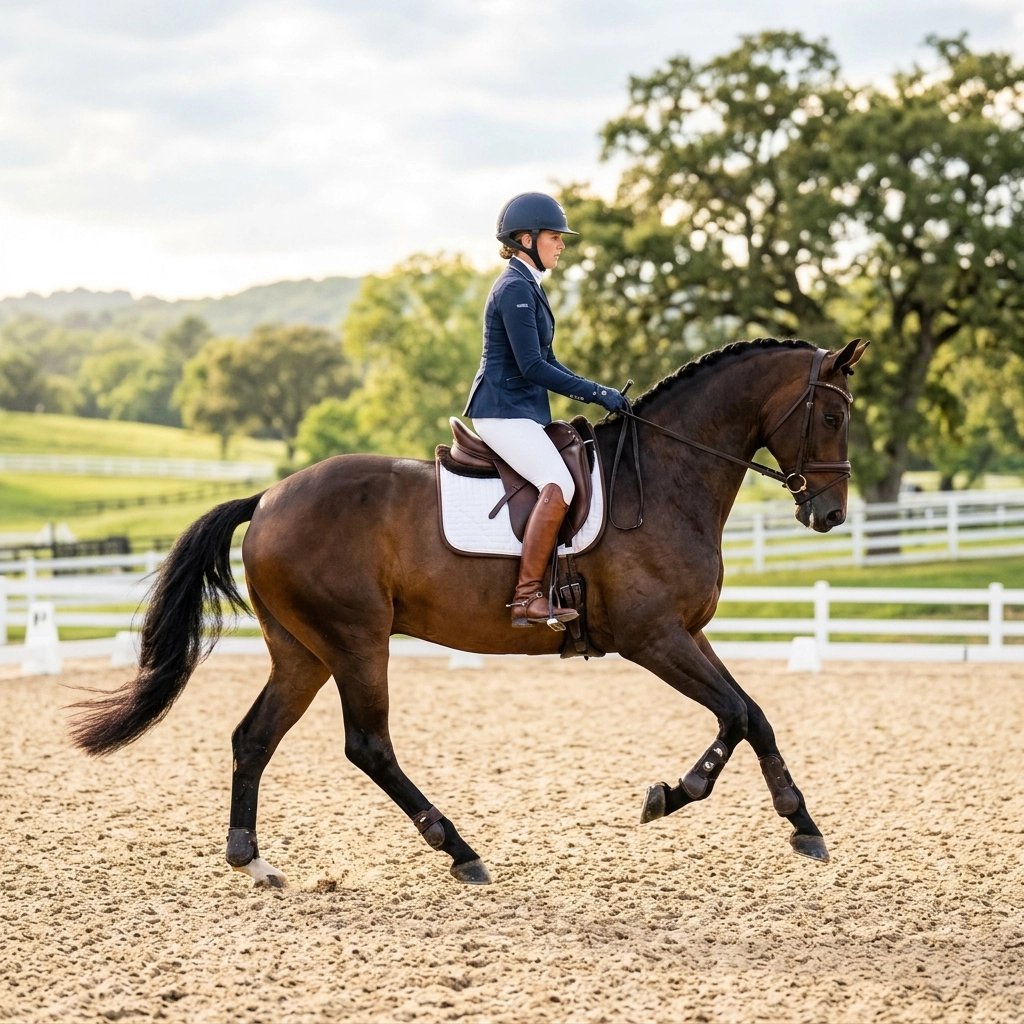
Are you tired of feeling like your horse’s head is about to hit you in the face every time you ask for a transition? Does it feel like you’ve finally established a beautiful, rhythmic trot, only for your horse to turn into a telescope the second you ask for the canter? You are definitely not alone! This is one of the most common frustrations in the dressage arena, but it doesn't have to be your "forever" reality.
It is time to smash those schooling plateaus and unlock the secrets to smooth, uphill, and connected transitions! At The Dressage Coach, we believe every rider has the potential to transform their horse’s posture from hollow and resistant to supple and swinging. Transitions are the "bread and butter" of dressage training, and mastering them is a journey of discovery that will supercharge your performance!
Let’s peel back the layers and look at the 10 reasons your horse is hollowing, and exactly how you can fix it today!
What’s happening: Imagine trying to start a car in fifth gear with a flat battery. That’s what it feels like for a horse when they lack impulsion! If the horse is shuffling along without a real push from the hind end, they have no "lift" to offer. When you ask for a change in gait, they pull themselves forward with the front end, drop their back, and throw their head up to compensate.
The Fix: You need to ignite the fire from behind! Before you even think about a transition, ride several laps focusing ONLY on a forward, swinging walk or trot. If your horse doesn't respond to a light leg aid, don't just nag, give a clearer, sharper aid, then immediately soften and praise the forward response!
Pro Tip: Practice transitions within the gait. Challenge yourself to ride a "bigger" walk and then a "smaller" walk. This teaches your horse to stay "in front of the leg" and keeps their back engaged without losing the connection!
What’s happening: Every transition is a moment of momentary instability. If your horse isn't prepared, they briefly lose their balance, fall onto their shoulders, and "pop" their head up to act as a balancing pole, much like a tightrope walker using their arms!
The Fix: Preparation is your best friend! You must become the architect of the transition at least 3–5 strides before it happens. Rebalance your horse with a gentle half-halt. For downward transitions, make them progressive. If you’re moving from trot to walk, imagine making the trot tiny, slow, and almost walk-like first. When the trot feels "repackaged," gently ask for the walk.

What’s happening: If your horse isn't honestly "into" the contact, they have nowhere to go when the gait changes. They escape the pressure or the shift in balance by lifting their neck and "dropping" the rein. Without a steady bridge between your hand and their mouth, the back naturally hollows.
The Fix: Aim for an elastic, living feel in both reins. You want the sensation of the horse seeking the bit. Remember: we never pull the head down; we drive the horse forward from the hind leg into a supportive hand. On a 20m circle, ask for a slight inside flexion. Maintain a steady outside rein to act as a "wall" for the horse to balance against. If they try to pop up, close your leg, squeeze the reins gently, and soften the instant they reach forward!
What’s happening: Your horse is a mirror! If you tip forward, brace your knees, or lean back and pull during a transition, your horse has to brace their back to carry you. If you are out of balance, they cannot possibly stay in balance.
The Fix: Conduct a Mindset Magic body scan! Ask yourself: If my horse suddenly disappeared, would I land on my feet? You should always maintain that classic vertical line: ear, shoulder, hip, heel. Before each transition, soften your thighs, let your weight drop into your stirrups, and keep your elbows bent. If you struggle with your own posture, consider a Mechanical Horse Session to isolate your movement without worrying about the horse!
What’s happening: It’s a natural instinct to want to "fix" the head with our hands. However, fiddling, see-sawing, or pulling back acts like a handbrake. The horse feels the restriction in their mouth, braces their jaw, and drops their back as a reaction.
The Fix: Adopt the golden rule: "My contact may close, but it may not pull." As you ask for the transition, ensure your seat and leg are the primary aids. Allow the neck to slightly lengthen into the new gait. If you find yourself getting "fiddly," take a breath, ride a large circle, and let the horse stretch. Check out our Rider Kit for tools that can help you develop a more stable and quiet hand!

What’s happening: If the hind legs are "left in the stable" (trailing behind the body), the back cannot physically lift. When the engine is unplugged, the horse goes hollow the moment you ask for a change.
The Fix: Use lateral work to engage the powerhouse! Ride a 20m circle and spiral in to a 10m or 12m circle. Keep that inside flexion and a solid outside rein. As you spiral back out, use a gentle leg-yield. This encourages the inside hind leg to step deep under the horse's center of gravity. Ask for your transition right as you reach the outer edge of the circle, you'll feel the difference immediately! To see exactly how your horse is using their hind end, many of our riders use a Pivo system to record and review their sessions!
What’s happening: We all want to progress quickly, but sometimes we ask for transitions that the horse simply isn't strong enough to perform yet. Asking for a walk-to-canter or a trot-to-halt before the horse has the core strength to sit results in a protective hollow.
The Fix: Choose accessible victories! Instead of a messy walk-to-canter, focus on a high-quality trot-to-canter. If the horse stays soft and relaxed, celebrate that win! Quality always beats quantity. Four correct, relaxed transitions are worth more than fifty hollow ones. Take it slow and embark on the "adventure" of building strength correctly.
What’s happening: Horses, like humans, have a "stiff" side and a "hollow" side. If a horse is crooked, they will fall in or out on a shoulder during a transition. This misalignment causes them to brace against the rider's aids and pop the head up.
The Fix: Ride your transitions on circles, not straight lines. A circle naturally encourages a certain level of bend and makes it harder for the horse to "run" away from the aid. Use your inside leg to drive them toward the outside rein. This "inside leg to outside rein" connection is the secret sauce to straightness!

What’s happening: We must always remember that a hollow back can be a sign of pain. If a horse’s back hurts, or if the saddle doesn't fit correctly, they will brace their muscles to protect themselves from the "sting" of a transition.
The Fix: Be a detective! Run your fingers along their spine to check for flinching. Ensure your saddle isn't pinching the shoulders or "bridging" across the back. If you suspect any discomfort, back off the intensity. Focus on stretchy, easy work and consult a professional. We always recommend keeping your horse’s environment comfortable too, quality bedding and regular bodywork are essential for the elite equine athlete!
What’s happening: If a horse expects a sharp aid or a pull on the mouth, they will begin to anticipate the transition with fear. They hold their breath, tighten their core, and hollow in self-defense. This becomes a cycle of tension that ruins the harmony between rider and horse.
The Fix: Make transitions boring! Yes, you read that right. We want transitions to be so predictable and quiet that the horse remains completely calm. On a 20m circle, do walk-trot-walk every half-circle. Use whisper-quiet aids. If your horse stays soft but is a second "late" to the aid, praise them anyway! We want to reward the relaxation first. Once the tension is gone, the "sharpness" will follow naturally.

Are you ready to gallop towards your dreams and leave hollowing in the past? Here is a simple session plan you can try today:
If you want more personalized guidance, our Remote Coaching is the perfect way to get expert eyes on your riding from anywhere in the world! You can also join our community on the The Dressage Coach App for daily tips and training videos.
Don't let hollowing hold you back from the scores and the feel you deserve. Unlock your horse's potential and transform your transitions today! Whether you need new Franklin Balls to improve your seat or a Dressage Uncovered guide to deepen your knowledge, we are here to support your journey every step of the way!
Claim your spot at the top of the leaderboard( let's get riding!) 🐎✨